Difference Between Motion and non-Motion Metal Detectors
Metal detectors are available with different operating modes, each designed to improve detection performance under specific conditions. Two commonly used terms in metal detecting are Motion and Non-Motion. These terms describe how a metal detector responds to a target when the search coil is moving or stationary.
Understanding the difference between Motion and Non-Motion detection is important when selecting a metal detector, especially if you want to identify buried objects accurately, reduce unnecessary digging, or locate targets in challenging ground conditions.
A Motion metal detector requires the search coil to move over a target to produce or maintain a detection response in its motion operating mode. These detectors are commonly associated with discrimination systems that analyze target responses as the coil passes over an object.
A Non-Motion metal detector, also known as a static detection system, can continue to produce a signal while the search coil remains stationary above a metal target. This makes static detection particularly useful for pinpointing, precise target localization, and certain specialized detecting applications.
However, Motion and Non-Motion do not represent two completely separate metal detecting technologies. They describe operating characteristics rather than the underlying electronic detection principle. Some modern metal detectors offer both operating modes, allowing users to benefit from each depending on the situation.
In this guide, we will explain how Motion and Non-Motion metal detectors work, examine their differences, advantages, and limitations, and discuss which operating mode is more suitable for recreational detecting, professional exploration, and treasure hunting.
1. What Is a Motion Metal Detector?
A Motion metal detector is a detector that requires movement of its search coil relative to a metal target to produce a detection response in its motion operating mode.
When the search coil moves across the ground, the detector continuously evaluates changes in the electromagnetic response received from the surrounding area. When a metal object enters the coil's detection field, the detector processes the resulting signal and generates an audio or visual indication.
If the search coil stops moving directly above the target, the detection response in a conventional motion-dependent mode will normally fade or disappear, even though the metal object remains underneath the coil.
This behavior is a characteristic of the detector's signal processing and operating mode.

How Does Motion Detection Work?
Motion detection is based on observing changes in the electromagnetic response as the search coil moves relative to a metal object.
The general operating process can be described in several stages:
1. Electromagnetic Field Generation
The search coil generates an electromagnetic field that penetrates the surrounding ground.
2. Interaction with a Metal Target
When the electromagnetic field encounters a metal object, it induces electrical currents within the target. These currents generate a secondary electromagnetic response.
3. Coil Movement and Signal Variation
As the search coil moves toward, across, and away from the target, the received electromagnetic response changes.
4. Signal Processing
The detector analyzes these changes and processes the received signal according to the selected operating mode.
5. Target Indication
When the response meets the detector's detection criteria, an audio signal, numerical Target ID, visual indication, or combination of these outputs is produced.
The detector may generate different tones or target identification values depending on the characteristics of the detected object and the capabilities of its electronic system.
Why Must the Search Coil Keep Moving?
In a motion-dependent operating mode, the detector's signal processing is designed to identify changes in the received signal associated with a moving search coil.
The detector may use filtering and automatic tuning or tracking functions to maintain a stable operating reference while the coil is swept across the ground.
When coil movement stops, the changing response used by that particular detection mode is no longer available. Consequently, the detector may stop producing the normal target signal.
This does not mean that the electromagnetic response from the metal object has disappeared. It means that the selected operating mode is no longer processing the stationary response as an ordinary detection event.
Motion Discrimination
One of the most important applications of Motion detection is metal discrimination.
Many VLF metal detectors use motion-dependent operating modes to analyze characteristics such as signal phase, amplitude, and conductivity-related responses as the search coil passes over a target.
Depending on the detector's design, the system may classify signals into different categories, identify ferrous and non-ferrous responses, and provide numerical Target ID values.
For example, a detector may produce different tones for iron, aluminum, copper, silver, and other metal targets.
However, target identification is an estimate rather than a guarantee. Different objects can produce similar electromagnetic responses, and factors such as target size, shape, depth, orientation, and soil conditions can influence the displayed identification.
Not every Motion detector offers the same level of discrimination. The actual capabilities depend on its electronics and signal processing.
Common Applications of Motion Metal Detectors
Motion operating modes are widely used in modern general-purpose metal detectors.
Typical applications include:
-
Searching for coins and historical metal objects.
-
Finding rings, jewelry, and small metal targets.
-
Recreational metal detecting in parks and fields.
-
Searching for non-ferrous objects in areas containing iron debris.
-
Identifying different target categories before digging.
-
General-purpose treasure hunting.
-
Detecting targets in environments where discrimination is important.
2. What Is a Non-Motion Metal Detector?
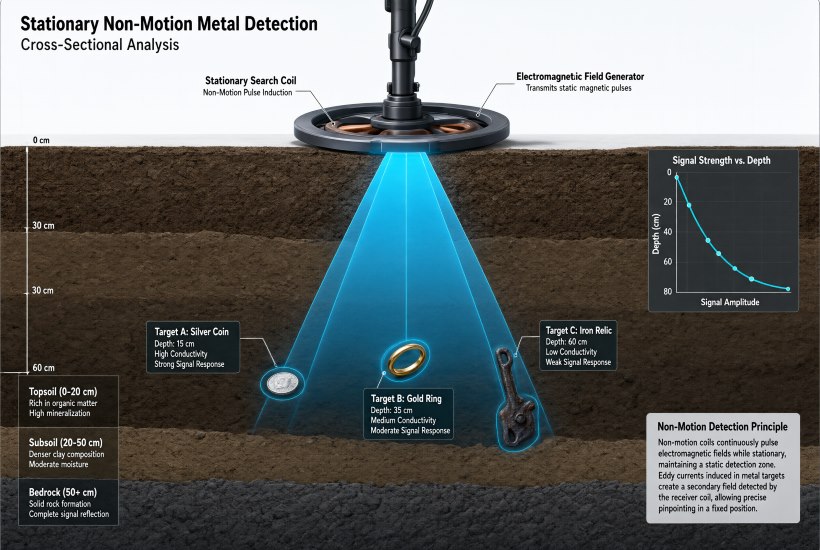
A Non-Motion metal detector is a detector that can identify a metal target without requiring continuous movement of the search coil.
This operating principle is also known as Static detection.
Unlike a conventional motion-dependent mode, a Non-Motion system can maintain an audio or visual response while the coil is held stationary above a target.
Many traditional Non-Motion detectors use an audible background signal known as a Threshold.
The operator adjusts the detector until a faint and stable background tone can be heard through the speaker or headphones.
When a metal object enters the detection field, the signal changes. Depending on the detector's design, the background tone may become louder, quieter, or otherwise change in a recognizable way.
The target response can continue while the search coil remains stationary above the object.
How Does Non-Motion Detection Work?
The general operating process of a static detection system is different from that of a motion-dependent mode.
1. Establishing the Operating Threshold
The detector is adjusted to produce a stable reference signal, which may be audible as a faint continuous tone.
2. Generating an Electromagnetic Field
The search coil generates the electromagnetic field used to detect nearby metal objects.
3. Detecting a Target Response
When a metal object enters the detection field, its electromagnetic response changes the detector's received signal.
4. Signal Comparison
The electronic circuit compares the received response with the established operating reference.
5. Continuous Target Indication
The detector produces a change in the audio or visual output. Unlike motion-dependent detection, the response can remain present while the coil is held stationary above the target.
What Is Threshold Tuning?
Threshold tuning is particularly important in many traditional Non-Motion detection systems.
The threshold is the reference level that allows the operator to recognize changes caused by nearby metal objects.
If the threshold is adjusted too high, small changes in the received signal may become difficult to recognize. If it is adjusted too low, weak target responses may not produce a clearly audible indication.
The ideal adjustment is generally a faint, stable background signal that allows even small changes to be noticed.
Some older or manually tuned systems require periodic readjustment because the operating threshold can drift with temperature changes, ground conditions, or other environmental factors.
Many modern detectors, however, include automatic threshold control or electronic tracking features that reduce the need for manual adjustment.
The Difference Between Retuning and Ground Balance
These two functions are sometimes confused, but they serve different purposes.
Retuning adjusts the detector's operating reference or audio threshold so that the background response returns to its desired level.
Ground Balance compensates for the response of naturally occurring minerals in the soil.
Both can improve stability, but they are not interchangeable. Adjusting the audio threshold does not necessarily eliminate ground mineralization, and performing Ground Balance does not automatically correct every form of threshold drift.
Common Applications of Non-Motion Metal Detection
Static detection is useful in several situations where maintaining a response without coil movement is important.
Common applications include:
-
Pinpointing the location of an already detected metal object.
-
Locating objects in excavation holes.
-
Searching slowly in areas where stationary detection is useful.
-
Certain specialized industrial and professional detecting applications.
-
Using handheld pinpointers to locate small objects in soil.
-
Identifying the center of a target before digging.
Non-Motion detection is particularly useful after a target has already been identified using another operating mode.
3. Motion vs. Non-Motion Metal Detectors: Main Differences
Although both systems are designed to detect metal objects, their operating characteristics are different.
The following table summarizes the most important differences.
| Feature | Motion Detection | Non-Motion Detection |
|---|---|---|
| Coil movement required | Yes, in motion-dependent modes | No |
| Detection with stationary coil | Normally stops in conventional motion mode | Continues |
| Signal behavior | Usually produces a response as the coil passes over a target | Can maintain a continuous target response |
| Operating principle | Evaluates changes associated with coil movement | Evaluates target response against a reference or threshold |
| Threshold adjustment | Often automated or less noticeable | May require manual adjustment |
| Retuning | Depends on detector design and settings | More important in traditional static systems |
| Target discrimination | Available in many motion modes | Often limited in traditional static all-metal modes |
| Target identification | Available on many modern detectors | Depends on the detector and selected mode |
| Pinpointing | Can require repeated coil sweeps | Particularly useful for stationary localization |
| Ease of operation | Generally easier for general-purpose searching | May require more manual adjustment |
| Common application | Searching and target discrimination | Static detection and precise target localization |
Note: These are general characteristics, not universal rules. Modern detectors differ significantly in their electronic design and available operating modes.
4. Advantages of Motion Metal Detectors
Motion detection has become the standard operating method in many modern recreational and general-purpose metal detectors.
Its main advantages include the following.
1. Easier Operation
Many Motion detectors automatically maintain their operating reference while searching.
This reduces the amount of manual tuning required and makes the detecting process easier for beginners and experienced users.
2. Better Integration with Discrimination Systems
Motion-dependent modes are commonly used with discrimination algorithms.
These systems can analyze target responses and help users distinguish between different categories of metal objects.
This is particularly useful in areas containing large amounts of iron debris and other unwanted metal targets.
3. Efficient General-Purpose Searching
Motion detectors are designed for continuous scanning over large areas.
A consistent sweeping movement allows the user to cover the ground efficiently while listening for target signals.
4. Useful Target Identification Features
Many modern Motion detectors provide visual Target ID numbers, different audio tones, and graphical target information.
These features can make target evaluation easier before digging.
5. Automatic or Continuous Operating Adjustments
Depending on the design, some Motion detectors continuously adjust their operating reference or track changes in ground conditions.
This can help maintain stable operation without frequent manual intervention.
Limitations of Motion Metal Detectors
Despite their advantages, Motion detection also has some limitations.
1. Continuous Coil Movement Is Necessary
The user must maintain an appropriate sweeping movement. A detector operating in a conventional motion mode may stop producing its normal target response when the coil remains stationary over an object.
2. Sweep Technique Is Important
The speed, height, and consistency of coil movement can affect detection performance.
Moving the coil too quickly, lifting it at the end of a sweep, or leaving large gaps between passes may result in missed targets.
3. Pinpointing Can Require Additional Steps
When using motion discrimination, the target response may disappear as soon as the coil stops.
The operator may therefore need to use a dedicated Pinpoint function or another method to determine the exact target location.
4. Discrimination Can Reject Some Valuable Targets
Discrimination systems are not perfect.
Some valuable objects may produce responses similar to unwanted metal objects. Excessive discrimination can therefore cause potentially interesting targets to be rejected.
5. Advantages of Non-Motion Metal Detectors
Non-Motion detection offers several useful features that complement conventional Motion operation.
1. Detection Without Continuous Coil Movement
The main advantage is the ability to maintain a target response while the search coil remains stationary.
This is useful when the operator wants to examine a target signal without continuously sweeping the coil.
2. Accurate Target Localization
Static detection can help identify the position of a detected object.
Once the approximate target location is known, the operator can slowly move the coil around the area and observe where the signal becomes strongest.
The coil can then be held over the target to confirm its position.
3. Useful for Pinpointing
Many metal detectors switch to a static all-metal operating mode when the Pinpoint button is activated.
This allows the user to locate the approximate center of an object more accurately before excavation.
4. Suitable for Slow and Detailed Searches
In some detecting applications, the ability to examine a response without maintaining a continuous sweeping movement is valuable.
This can be helpful when checking difficult targets or working in restricted spaces.
5. Useful for Specialized Detection Tasks
Certain professional metal detection systems are designed to offer static detection as one of their operating modes.
In these applications, stationary response capability can be an important operational feature.
Limitations of Non-Motion Metal Detectors
1. Greater Dependence on Threshold Stability
Traditional static systems often require a carefully adjusted operating threshold.
Changes in temperature, ground conditions, and environmental interference may affect the background response.
2. Manual Retuning May Be Necessary
Some Non-Motion detectors require periodic retuning to maintain a stable audio threshold.
This can interrupt the search process and require additional user attention.
3. More Limited Discrimination in Many Traditional Systems
Many static detection systems operate in an All-Metal mode.
In this configuration, the detector responds to different types of metal without providing the same discrimination capabilities available in many motion-dependent VLF modes.
However, this limitation depends on the detector's design and is not a universal property of every Non-Motion system.
4. More Sensitive to Operating Conditions in Some Designs
Older or basic static detectors may produce unstable responses when the coil height changes or when the ground conditions vary.
Advanced systems can reduce these problems through automatic tuning, ground compensation, and signal processing.
6. What Is the Difference Between Motion Mode and Discrimination Mode?
Motion and Discrimination are closely associated in many metal detectors, but they are not exactly the same thing.
Motion describes whether coil movement is required for the selected mode to detect a target.
Discrimination describes the detector's ability to classify target responses and accept or reject selected categories of metal objects.
Many conventional VLF detectors use motion-dependent Discrimination modes. In these detectors, the search coil must move over the target for the discrimination system to work correctly.
For example, when the user selects an Iron Reject or Notch function, the detector analyzes the target response and may suppress the audio indication associated with selected metal categories.
This can help reduce unwanted signals from iron objects, bottle caps, and other metal debris.
However, it is important to understand that Motion does not automatically mean Discrimination.
Some detectors offer Motion All-Metal modes that require coil movement but do not reject metal targets.
Similarly, a Non-Motion mode is often associated with static All-Metal detection, but the exact functions depend on the detector's electronics.
The operating manual should always be checked to understand how these features work on a particular model.
7. What Is Pinpoint Mode and How Does It Relate to Non-Motion Detection?
Pinpoint is a feature available on many modern metal detectors that helps users determine the approximate center of a detected metal object.
During normal searching, a detector may be operating in a Motion Discrimination mode. When a target is detected, its approximate location is identified by sweeping the coil across the area.
The user can then activate Pinpoint mode to improve localization.
On many detectors, activating Pinpoint temporarily changes the detector to a Non-Motion or static All-Metal operating mode.
The detector can then maintain an audio response while the search coil is held above the target.
How to Pinpoint a Target
A practical pinpointing procedure is as follows:
Step 1: Identify the Target
Search the area using the normal detecting mode until the detector produces a repeatable target signal.
Step 2: Move the Coil Away
Move the coil slightly away from the approximate target location before activating Pinpoint, as recommended by the detector manufacturer.
Step 3: Activate Pinpoint Mode
Press the Pinpoint button to switch to the static detection function.
Step 4: Move the Coil Slowly
Move the coil slowly across the target area in one direction.
Observe the signal strength and identify where the response is strongest.
Step 5: Check from Another Direction
Repeat the procedure at approximately 90 degrees to the initial direction.
This helps narrow down the target's location.
Step 6: Identify the Center
The strongest or most clearly localized response generally indicates the approximate center of the target, depending on the coil design and detector's pinpoint function.
The exact method may vary between concentric, DD, and specialized search coils. Always follow the manufacturer's instructions.
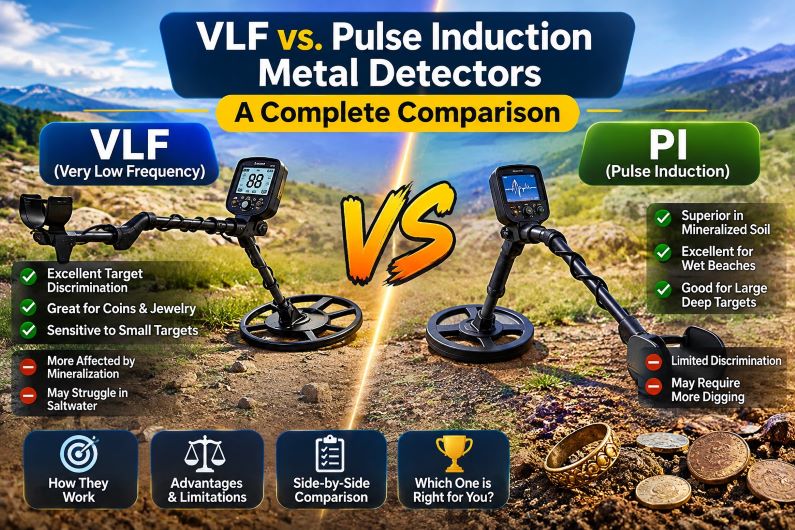
8. Are Motion and Non-Motion Related to VLF and PI Technologies?
This is an important point that is often misunderstood.
VLF and PI describe different electronic methods of generating and analyzing electromagnetic signals.
Motion and Non-Motion describe how a detector behaves when its search coil moves or remains stationary.
These are two different classifications.
A VLF detector may offer Motion Discrimination and a Non-Motion Pinpoint function.
Some PI detectors also offer both Motion and static operating modes.
Therefore, it is incorrect to assume that all VLF detectors are Motion detectors or that all PI detectors are Non-Motion detectors.
A detector's transmission technology does not automatically determine whether it requires coil movement in a particular operating mode.
For a more detailed explanation of these technologies, read our guide:
VLF vs. PI Metal Detectors: A Complete Comparison
9. Which Is Better for Recreational Metal Detecting?
For most recreational metal detecting activities, a detector with a Motion Discrimination mode is generally the more practical choice.
Most recreational users search for coins, rings, jewelry, historical objects, and other metal targets in parks, fields, beaches, and ordinary soil.
In these environments, the ability to continuously scan an area and receive information about the probable type of target is particularly useful.
Motion Discrimination allows users to evaluate different metal responses while moving the coil over the ground.
This can reduce unnecessary digging, especially in locations containing many iron objects and metal fragments.
However, having a Non-Motion Pinpoint function is also beneficial.
Once a target is detected, switching to a static mode can help identify its approximate center and make excavation easier.
Recommendation: For recreational detecting, a modern metal detector with both Motion Discrimination and Non-Motion Pinpointing is generally a very practical combination.
10. Which Is Better for Professional Metal Detecting and Treasure Hunting?
The answer depends on the type of search and the detector's intended application.
Professional metal detecting does not always require the same operating characteristics as recreational detecting.
Some applications prioritize discrimination and target identification, while others focus on detecting all metal objects and accurately locating their positions.
Applications Where Motion Is More Useful
Motion detection is especially valuable in search areas containing many different metal objects.
Examples include:
-
Historical locations with mixed metal debris.
-
Areas where iron rejection is important.
-
Coin and artifact recovery.
-
General-purpose professional detecting.
-
Searching large areas efficiently.
-
Applications requiring numerical Target ID and discrimination.
In these situations, the ability to analyze target responses while sweeping the coil can significantly improve search efficiency.
Applications Where Non-Motion Is More Useful
Static detection can be particularly valuable when the approximate location of an object is already known or when continuous movement is not practical.
Examples include:
-
Pinpointing a buried metal object.
-
Locating targets inside an excavation.
-
Searching in confined spaces.
-
Specialized static metal detection applications.
-
Certain professional systems designed for stationary target detection.
Is One Mode More Powerful or Deeper Than the Other?
There is no universal rule stating that Motion or Non-Motion detection always provides greater depth.
Detection depth depends on several factors, including:
-
Search coil size and design.
-
Target size, shape, and metal composition.
-
Detector electronics and signal processing.
-
Operating frequency or pulse characteristics.
-
Ground mineralization and conductivity.
-
Sensitivity and ground balance settings.
-
The selected operating mode and its signal processing limitations.
Some detectors may provide different performance in Motion and Non-Motion modes, but this must be evaluated according to the specific model.
The operating mode alone is not a reliable measure of maximum detection depth.
11. Do Modern Metal Detectors Support Both Motion and Non-Motion Modes?
Many modern metal detectors offer both types of operation through separate search modes or dedicated controls.
For example, a detector may operate in Motion Discrimination mode during normal searching and switch to static detection when the user presses the Pinpoint button.
Other detectors may provide separate All-Metal, Motion All-Metal, and Non-Motion modes.
This design gives users more flexibility because each mode serves a different purpose.
Motion mode can be used to search larger areas and evaluate target responses, while static detection can be used to examine and locate specific targets.
However, not every detector offers both modes, and the available functions differ between manufacturers and models.
Before purchasing a detector, it is important to check whether it supports:
-
Motion Discrimination.
-
Motion All-Metal operation, if required.
-
Static or Non-Motion All-Metal operation.
-
Dedicated Pinpoint mode.
-
Automatic or manual retuning.
-
Adjustable Ground Balance.
-
Target ID and audio discrimination.
A detector offering several operating modes can be more versatile, but the quality of each mode is more important than simply having a long list of features.
12. How to Choose the Right Metal Detector?
When choosing a metal detector, consider the following factors rather than relying only on the terms Motion and Non-Motion.
1. Intended Application
For general coin and jewelry hunting, Motion Discrimination is particularly useful.
For precise target localization, static detection and Pinpoint functions are valuable.
2. Target Discrimination
If you need to distinguish between different metal categories, examine the detector's discrimination system and Target ID capabilities.
3. Ground Conditions
Highly mineralized soil, wet saltwater sand, and changing ground conditions can influence detector performance. Look for suitable Ground Balance and ground compensation features.
4. Operating Stability
A detector should maintain a stable response under normal operating conditions. Excessive false signals and threshold drift can make detecting difficult.
5. Search Coil Design
The search coil affects target sensitivity, detection field characteristics, target separation, and overall performance.
6. Available Operating Modes
Choose a detector that provides the operating modes required for your intended applications.
7. Ease of Use and Adjustment
Beginners may benefit from automatic tuning and simple operating controls, while experienced users may prefer more manual adjustments.
8. Real-World Testing
Whenever possible, compare detectors using the same metal targets, search coil conditions, and ground environment.
Testing is more useful than relying exclusively on advertised performance figures.
13. Final Verdict: Motion or Non-Motion Metal Detectors?
Motion and Non-Motion detection are two complementary operating methods, each with its own advantages and limitations.
Motion detection is generally more suitable for everyday metal detecting, especially when searching large areas and using discrimination to identify or reject unwanted targets.
It offers convenient operation and is widely available in modern recreational and professional detectors.
Non-Motion detection is particularly useful when the search coil needs to remain stationary while maintaining a target response. It is valuable for pinpointing, accurately locating objects, and certain specialized applications.
Traditional Non-Motion systems may require more attention to threshold tuning and retuning, although modern designs can automate some of these adjustments.
For most users, the most versatile option is a metal detector that provides both Motion Discrimination and a reliable Non-Motion Pinpoint function.
This combination allows the operator to search efficiently, evaluate target responses, and accurately locate detected objects before digging.
The most important consideration is not whether a detector is classified as Motion or Non-Motion, but how effectively its available operating modes perform for the intended application.
Understanding these differences will help you select the right equipment and use it more effectively in different detecting environments.
Frequently Asked Questions (FAQ)
What is the main difference between Motion and Non-Motion metal detectors?
The main difference is whether the search coil must move to maintain a target detection response. Motion detectors require coil movement in their motion operating modes, while Non-Motion detectors can continue to detect a target when the coil remains stationary.
Can a Motion metal detector detect a target without moving the coil?
Not in its conventional motion-dependent operating mode. However, many modern detectors include a Pinpoint or static All-Metal function that allows detection without continuous coil movement.
Are Non-Motion detectors better for deep targets?
Not necessarily. Non-Motion operation does not automatically provide greater detection depth. Actual performance depends on the detector design, search coil, target characteristics, soil conditions, and operating settings.
Do Motion metal detectors have better discrimination?
Many modern Motion Discrimination modes provide effective target classification and rejection capabilities. However, discrimination performance depends on the electronic design rather than coil movement alone.
Is a VLF metal detector always a Motion detector?
No. VLF describes the underlying detection technology, while Motion describes an operating mode. A VLF detector can include both Motion Discrimination and Non-Motion Pinpoint functions.
Are PI metal detectors Non-Motion detectors?
No. PI describes Pulse Induction technology and does not automatically determine whether coil movement is required. Some PI detectors offer static detection, Motion operation, or both, depending on their design.
Is Pinpoint mode the same as Non-Motion mode?
Not exactly. Pinpoint is a function designed to locate the approximate center of a detected target. Many detectors achieve this by switching to a Non-Motion static detection mode, but the precise implementation varies between models.
Why does my metal detector stop producing a signal when I stop moving the coil?
Your detector may be operating in a motion-dependent mode. In this mode, the electronics analyze changes in the received signal as the coil passes over a target. When movement stops, the normal detection response may disappear. Switching to Pinpoint or static All-Metal mode may allow the detector to maintain the signal.
Do Non-Motion detectors require manual tuning?
Traditional Non-Motion systems often require manual threshold adjustment and occasional retuning. However, some modern detectors include automatic tuning or tracking features that reduce the need for manual adjustments.
Which is better for professional treasure hunting?
Both can be useful. Motion detection is advantageous when discrimination and searching large areas are important, while Non-Motion detection is valuable for pinpointing and specialized static detection tasks. A detector with both modes can provide greater operational flexibility.