VLF vs. Pulse Induction Metal Detectors: A Complete Comparison
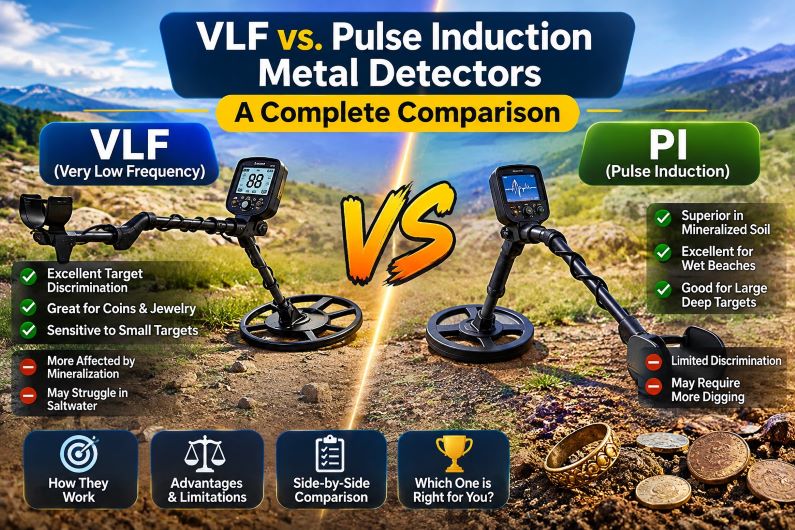
Metal detectors use different technologies to identify buried metal objects. Among the most widely used technologies are VLF (Very Low Frequency) and PI (Pulse Induction). Both systems are designed to detect metal objects underground, but they use different methods to transmit electromagnetic signals and analyze the responses received from metal targets.
If you are planning to purchase a metal detector for searching for coins, jewelry, gold, historical objects, or larger buried metal targets, understanding the differences between these two technologies is essential.
VLF metal detectors are generally known for their target discrimination capabilities, sensitivity to many small objects, and ability to identify different types of metal. They are widely used for recreational detecting, coin hunting, jewelry hunting, and various professional applications.
Pulse Induction detectors, on the other hand, are particularly valuable in highly mineralized soils, saltwater environments, and other challenging ground conditions. Their different signal transmission and reception method allows them to operate more effectively in many environments where conventional VLF detectors may experience interference.
Neither technology is universally better than the other. Each has specific advantages and limitations, and the right choice depends on the type of target, ground conditions, required detection depth, and the purpose of the search.
To understand which technology is more suitable for your needs, let us first examine how each system works.
1. What Is a VLF Metal Detector and How Does It Work?
VLF stands for Very Low Frequency. It is one of the most widely used technologies in modern metal detectors and is commonly found in recreational, general-purpose, and advanced detecting equipment.
A VLF metal detector generates an alternating electromagnetic field through its search coil. When this field interacts with a metal object, it induces small electrical currents inside the object, known as eddy currents.
These eddy currents generate a secondary electromagnetic field, which is detected by the metal detector's receiving circuit. The detector analyzes the characteristics of the received signal and compares them with the transmitted signal to determine whether a metal object is present.
One of the most important characteristics of VLF technology is its ability to analyze the phase shift between the transmitted and received signals.
The phase relationship, together with signal amplitude and other response characteristics, provides information about the electrical conductivity and magnetic properties of the target. The detector uses this information to estimate the target's characteristics and classify it into different response categories.
Many VLF detectors provide a numerical Target ID, audio tones, and discrimination settings. These features help users distinguish between different target responses and reduce unwanted signals from certain types of metal objects.

Main Components of a VLF Detection System
A typical VLF metal detector includes several important components:
-
Transmit Coil: Generates the electromagnetic field used to search the ground.
-
Receive Coil: Detects changes in the electromagnetic field caused by nearby metal objects.
-
Signal Processing Circuit: Analyzes the amplitude, phase, and other characteristics of the received signal.
-
Discrimination System: Classifies target responses into different categories and allows users to reject certain unwanted metal responses.
-
Ground Balance System: Reduces the effects of mineralized soil and helps maintain stable detector performance.
In many traditional VLF designs, the transmit and receive coils are arranged in an Induction Balance configuration. This arrangement minimizes the direct electromagnetic coupling between the transmitting and receiving sections when no target is present.
Common Applications of VLF Metal Detectors
VLF technology is suitable for a wide range of metal detecting activities, including:
-
Searching for old and modern coins.
-
Finding rings, bracelets, and other jewelry.
-
Detecting small metal objects.
-
Searching in parks, fields, and ordinary soil conditions.
-
Locating buried metal objects and historical items.
-
Gold prospecting with specialized high-frequency models.
-
Searching in dry beaches and areas with relatively low ground mineralization.
Advantages of VLF Metal Detectors
1. Better Target Discrimination
One of the main advantages of VLF technology is its ability to analyze the characteristics of metal responses and distinguish between different target categories.
Many VLF detectors can identify ferrous and non-ferrous target responses and provide numerical Target ID information.
This allows users to estimate the possible type of target before digging. In suitable conditions, it can significantly reduce unnecessary digging caused by unwanted iron objects and metal debris.
2. Good Sensitivity to Small Targets
Many VLF detectors, especially models operating at higher frequencies, offer excellent sensitivity to small metal objects such as tiny gold nuggets, thin coins, and small pieces of jewelry.
Choosing the appropriate operating frequency can have a significant effect on a detector's ability to locate small targets.
3. Good Performance in Low to Moderately Mineralized Soil
In areas where ground mineralization is relatively low, VLF detectors can provide accurate and stable detection.
Under these conditions, Target ID information and discrimination performance are generally more reliable than in highly mineralized environments.
4. Suitable for Beginners and Recreational Users
Many VLF detectors include user-friendly controls, numerical displays, target identification systems, and discrimination settings.
These features make them relatively easy to learn and operate, especially for beginners who want to search for coins, jewelry, and other common metal objects.
5. Wide Range of Models and Features
The market offers a large variety of VLF detectors with different operating frequencies, search coil sizes, ground balance systems, and detection features.
This variety makes it easier to select a detector according to budget, experience, and intended application.
Disadvantages and Limitations of VLF Metal Detectors
Despite their advantages, VLF detectors have some limitations, particularly in challenging ground conditions.
1. Sensitivity to Ground Mineralization
One of the main limitations of VLF technology is its sensitivity to naturally occurring minerals in the soil.
Soils containing magnetite, iron oxides, and other mineral components can generate unwanted electromagnetic responses. These responses may interfere with the detection of buried metal targets.
As a result, the detector may become unstable, lose effective detection depth, or provide less reliable Target ID readings.
2. More Difficult Operation in Highly Mineralized Ground
In areas containing strongly mineralized soil or black sand, operating a VLF detector can become more challenging.
Although Ground Balance systems can reduce the effects of mineralization, they cannot always eliminate all ground interference.
3. Saltwater Interference
Saltwater and wet conductive beach sand can produce significant electrical responses.
These responses may cause instability, false signals, or reduced target identification accuracy in some single-frequency VLF detectors.
4. Performance Changes in Highly Variable Ground
When ground mineralization changes rapidly over a short distance, a VLF detector may require ground balance adjustments.
Without proper adjustment, the detector may produce unwanted signals or experience reduced detection performance.
2. What Is a Pulse Induction (PI) Metal Detector and How Does It Work?
PI stands for Pulse Induction. Unlike conventional VLF detectors, which transmit a continuous alternating electromagnetic signal, Pulse Induction detectors use short electrical pulses to generate a magnetic field.
This difference in signal transmission and reception is the foundation of PI technology.
A PI detector sends a short electrical current through its search coil, creating a magnetic field around the coil.
After a short period, the current is switched off and the magnetic field begins to collapse.
When a metal object is located within the magnetic field, electrical currents are induced inside the object. These currents are known as eddy currents and continue to flow briefly after the original magnetic field has been switched off.
The eddy currents create their own secondary magnetic field, which gradually decreases over time.
The detector measures this changing electromagnetic response during a specific time interval after the transmitted pulse ends.
By analyzing the signal strength and its decay characteristics, the detector can identify the presence of a metal object.

The Main Stages of Pulse Induction Detection
The operation of a PI detector can be divided into four main stages:
Stage 1: Pulse Transmission
The detector sends a short electrical current pulse through its search coil, generating a magnetic field.
Stage 2: Pulse Interruption
After a specified period, the electrical current is switched off and the primary magnetic field rapidly collapses.
Stage 3: Target Signal Reception
The detector measures the remaining electromagnetic response generated by eddy currents in nearby metal objects.
Stage 4: Signal Processing
The electronic circuit analyzes the received signal and its decay characteristics to determine whether a metal object is present.
This cycle is repeated many times per second. The detector processes the resulting signals to provide audio or visual indications of detected metal targets.
Why Do PI Detectors Perform Better in Highly Mineralized Soil?
One of the most important advantages of Pulse Induction technology is its ability to operate more effectively in many types of highly mineralized soil.
Naturally occurring minerals can also produce electromagnetic responses when exposed to the detector's magnetic field. In some VLF systems, these ground responses can overlap with the signals produced by metal targets, making detection more difficult.
PI detectors use a different signal measurement method. After the transmitted pulse ends, the detector measures the response of the surrounding environment during specific time intervals.
Some mineralized soils produce relatively predictable time-dependent responses. With appropriate circuit design and signal processing, a PI detector can compensate for or reduce a significant part of this unwanted ground response.
This is one of the main reasons why PI detectors often provide more stable performance than conventional VLF detectors in highly mineralized soil.
However, this does not mean that Pulse Induction detectors are completely unaffected by ground minerals. Soil composition, mineralization level, pulse timing, coil design, and signal processing still influence their performance.
Common Applications of Pulse Induction Metal Detectors
PI detectors are particularly useful in situations where ground stability and the ability to detect metal targets in difficult environments are important.
Common applications include:
-
Searching in highly mineralized soil.
-
Detecting metal objects in areas containing magnetic minerals.
-
Searching on wet beaches and in saltwater environments with suitable models.
-
Searching for large buried metal objects.
-
Gold prospecting in heavily mineralized regions.
-
Detecting metal targets in environments where conventional VLF detectors experience significant interference.
-
Specialized industrial, military, and unexploded ordnance (UXO) detection applications.
Advantages of Pulse Induction Metal Detectors
1. Better Performance in Highly Mineralized Ground
The most important advantage of PI technology is its ability to operate relatively stably in ground conditions that can cause problems for conventional metal detectors.
In highly mineralized soil, some PI detectors can identify metal targets more effectively than VLF detectors that struggle with ground interference.
2. Better Performance in Certain Beach Environments
Wet sand and saltwater can create significant interference for many single-frequency VLF detectors.
Pulse Induction detectors are generally less affected by these conditions and are often preferred for detecting on wet saltwater beaches.
3. Suitable for Mineralized Areas
In many natural environments containing high concentrations of mineralized materials, VLF detectors may experience reduced effective depth and increased ground noise.
PI technology can offer a significant advantage in such conditions.
4. Suitable for Large and Deep Metal Targets
Many PI detectors are designed to detect larger buried metal objects and can perform well at greater depths under suitable conditions.
Their ability to operate effectively in difficult ground conditions can make them particularly useful for specialized metal detecting applications.
However, actual detection depth depends on target size, target material, search coil dimensions, detector design, and soil conditions. Pulse Induction technology alone does not guarantee greater depth in every situation.
5. Useful for Specialized Gold Prospecting
In highly mineralized gold-bearing areas, PI detectors can be an effective choice for finding natural gold nuggets, particularly when ground interference limits the performance of conventional VLF detectors.
Disadvantages and Limitations of Pulse Induction Metal Detectors
1. More Limited Target Discrimination in Many Models
One of the main disadvantages of conventional PI detectors is their more limited ability to distinguish between different types of metals.
Many PI detectors are primarily designed to identify the presence of a metal target by analyzing its electromagnetic response. Unlike many VLF detectors, they do not always provide accurate separation between ferrous and non-ferrous metals.
Some advanced PI detectors offer iron rejection and other discrimination features, but these capabilities are not necessarily equivalent to the detailed discrimination systems found in many VLF detectors.
2. More Digging for Unwanted Metal Targets
Because discrimination is limited in many PI models, they may respond to unwanted metal objects such as iron fragments, nails, cans, and other metal debris.
As a result, users may need to dig more signals and physically examine more detected objects.
3. More Difficult Target Identification Before Digging
Many PI detectors cannot reliably identify the exact type of metal from the signal alone.
Determining whether a target is made of iron, copper, brass, silver, gold, or another metal may require direct examination or additional testing.
4. Requires Experience with Settings and Signal Interpretation
Settings such as sensitivity, ground balance, audio threshold, and pulse delay can have a significant effect on the performance of some PI detectors.
Incorrect adjustments may reduce sensitivity to certain targets or increase unwanted ground responses.
5. Some Small Targets May Be Missed at Longer Pulse Delays
In certain PI detector designs, increasing the Pulse Delay can help reduce the effects of unwanted ground responses.
However, a longer delay may also reduce sensitivity to some very small or low-conductivity metal targets.
Therefore, the choice of pulse timing often involves balancing ground stability against sensitivity to different target types.
3. VLF vs. PI Metal Detectors: A Performance Comparison
Now that we understand how these two technologies work, we can compare their main characteristics.
| Feature | VLF Metal Detectors | PI Metal Detectors |
|---|---|---|
| Signal transmission | Continuous alternating electromagnetic signal | Short magnetic pulses |
| Signal reception | Analysis of signal amplitude and phase | Measurement of time-dependent signal decay |
| Target discrimination | Generally very good | Often limited, depending on the model |
| Target ID display | Available on many models | Often limited or less detailed |
| Performance in normal soil | Very good | Good |
| Performance in highly mineralized soil | May be limited by ground interference | Generally better |
| Wet saltwater beach performance | Can be difficult for some single-frequency models | Generally better |
| Sensitivity to small targets | Very good in many models | Depends on coil design and pulse timing |
| Coin and jewelry hunting | Excellent | Suitable in some situations, but with less discrimination |
| Natural gold prospecting | Excellent for suitable small targets and ground conditions | Often preferred in highly mineralized goldfields |
| Large metal targets | Very good | Very good in many applications |
| Unwanted target rejection | Generally better | Often more limited |
| Digging unwanted targets | Usually less frequent | May be more frequent |
| Ease of use | Generally beginner-friendly | Depends on the model and settings |
| Common applications | Recreational, general-purpose, and professional detecting | Specialized detecting and difficult ground conditions |
Note: This table describes the general characteristics of the two technologies. Actual performance depends on the detector model, electronic design, search coil, settings, target characteristics, and ground conditions.
4. Which Metal Detector Has Greater Detection Depth: VLF or PI?
One of the most frequently asked questions when choosing a metal detector is which technology can detect metal objects at greater depths.
In many challenging ground conditions, particularly in highly mineralized soil, PI detectors can achieve greater effective detection depth than conventional VLF detectors.
One important reason is that some PI systems can manage mineralization-related interference more effectively, allowing them to maintain better sensitivity to buried targets.
However, this does not mean that PI detectors always have greater depth in every environment.
Actual metal detection depth depends on several important factors.
Target Size: Large metal objects can generally be detected from greater distances than small objects. The detection depth of a large metal container cannot be compared directly with that of a small coin.
Target Material and Conductivity: Different metals have different electrical and magnetic properties. These properties influence the strength and characteristics of the electromagnetic response.
Search Coil Size and Design: Larger search coils can often provide better performance on larger and deeper targets. However, they may reduce sensitivity to very small objects and make it more difficult to separate closely spaced targets.
Ground Conditions: Mineralization, soil conductivity, moisture, and other environmental characteristics can significantly influence detection performance.
Electronic Design and Signal Processing: The quality of the transmitter, receiver, signal processing circuit, and noise reduction algorithms plays an important role in the actual performance of a detector.
Detector Settings: Sensitivity, ground balance, operating frequency, pulse delay, and other settings must be adjusted according to the search environment.
For these reasons, comparing two detectors based only on their advertised maximum depth is not a reliable method.
A meaningful comparison requires testing both detectors with the same targets, appropriate search coils, comparable settings, and similar ground conditions.
5. Which Technology Is Better for Recreational Metal Detecting?
If your main goal is recreational metal detecting, such as searching for coins, jewelry, rings, and small metal objects in parks, fields, ordinary soil, dry beaches, or rural areas, a VLF detector is often the more suitable choice.
The main reason is its target discrimination capability and its ability to provide more information about detected objects before digging.
For example, imagine searching in an area containing several buried metal objects. Some may be coins or jewelry, while others may be iron fragments, nails, or unwanted metal debris.
A suitable VLF detector can use its Target ID and discrimination system to provide an estimate of the type of metal response.
This helps users focus on more interesting signals and avoid digging every unwanted metal target.
In contrast, a conventional PI detector with limited discrimination may respond to many different metal objects, requiring the user to dig and examine more signals.
However, on wet beaches, in saltwater environments, or in areas with highly mineralized soil, a PI detector or a suitable modern multi-frequency detector may be a better choice.
Recommendation for recreational detecting: For most ordinary recreational applications, VLF is generally the better starting point because of its target identification capabilities, discrimination, and ease of use. A simultaneous multi-frequency detector can also be an excellent option for users who search in a variety of environments.
6. Which Technology Is Better for Professional Metal Detecting and Treasure Hunting?
Choosing a metal detector for professional detecting depends on the type of target, ground conditions, required detection depth, and the nature of the search operation.
Professional detecting often involves more challenging environments than ordinary recreational searches.
The ground may contain high concentrations of mineralized materials, targets may be buried deeper, or the detector may need to operate in conditions where conventional metal detectors experience significant interference.
Under these circumstances, Pulse Induction technology can provide an important advantage.
Why Can PI Be More Suitable for Some Professional Applications?
In highly mineralized areas, VLF detectors may experience increased ground noise, reduced effective detection depth, and less reliable target identification.
PI detectors can operate more stably in many of these conditions and may be more suitable for locating buried metal targets, especially larger objects.
For this reason, PI technology is widely used in some specialized gold prospecting, metal detecting, and difficult-ground applications.
Are VLF Detectors Unsuitable for Professional Detecting?
No. It is incorrect to assume that VLF detectors are designed only for recreational use.
Advanced VLF detectors can provide excellent results in professional coin hunting, historical object detection, gold prospecting, and many other specialized applications.
In situations where identifying the probable type of metal is important, or where a site contains a large number of unwanted metal objects, the discrimination capabilities of a VLF detector can be a major advantage.
For example, in an area containing numerous iron objects mixed with potentially valuable non-ferrous targets, the ability to distinguish between different target responses can significantly improve search efficiency.

Choosing a Technology According to the Target Type
-
Coins and small metal objects: VLF is generally the better choice.
-
Jewelry and precious metal items: VLF is often preferable because of its discrimination and sensitivity.
-
Small natural gold nuggets: High-frequency VLF detectors can provide excellent performance in suitable ground conditions.
-
Gold prospecting in highly mineralized soil: PI can offer an advantage, depending on nugget size and ground conditions.
-
Large buried metal objects: PI can be particularly suitable for many searches in difficult ground.
-
Areas containing substantial iron and metal debris: VLF can be more efficient because of its better discrimination capabilities.
-
Wet beaches and saltwater environments: PI or a suitable simultaneous multi-frequency detector is often the better choice.
It is important to understand that neither technology can prove that a detected object is treasure, gold, or a valuable historical artifact. A metal detector identifies the presence of metal and provides information about its electromagnetic response. Determining the actual nature and value of an object generally requires further examination.
7. Multi-Frequency Technology: An Alternative to Traditional VLF and PI Detectors
In addition to VLF and PI technologies, modern metal detectors are increasingly available with Multi-Frequency technology.
Unlike conventional single-frequency detectors, multi-frequency systems can operate using multiple frequencies simultaneously or through other frequency-selection and processing methods, depending on the detector design.
Lower frequencies are generally useful for detecting larger or more conductive targets, while higher frequencies can offer greater sensitivity to certain small or low-conductivity targets.
By analyzing responses from multiple frequencies, these detectors can improve target identification and provide a useful balance between target sensitivity, discrimination, and performance in different ground conditions.
One important advantage of simultaneous multi-frequency technology is its ability to process information from several operating frequencies together.
This can help maintain accurate target identification across a wider range of target sizes and types and improve performance in certain challenging environments, including wet saltwater sand.
However, it is important to understand that Multi-Frequency is not the same as Pulse Induction.
Many simultaneous multi-frequency detectors are based on continuous-wave or induction-balance principles rather than pulse induction. Therefore, the actual operating architecture should always be checked in the manufacturer's technical specifications.
For users who want one detector for different environments, such as parks, fields, rural areas, and beaches, a good multi-frequency detector can be an attractive option.

8. What Should You Consider When Buying a VLF or PI Metal Detector?
Choosing a suitable metal detector should not be based only on advertised detection depth or the technology name.
Before purchasing a detector, several important factors should be considered.
1. Target Type
Are you searching for coins and small jewelry, or are you looking for larger metal objects buried deeper underground?
For small targets and applications requiring good discrimination, VLF is generally more suitable.
For searches in highly mineralized ground and difficult environments, PI may be the better option.
2. Ground Conditions
If you mainly search in ordinary soil, a good VLF detector can provide excellent performance.
However, if you search in highly mineralized soil, black sand, or other challenging environments, PI detectors should also be considered.
3. Target Discrimination and Target ID
If you want to avoid digging every metal signal, the quality of the discrimination system and Target ID becomes particularly important.
A detector with reliable target identification can help reduce unnecessary digging in areas containing significant amounts of metal debris.
4. Search Coil Size and Type
Different search coils can produce different results when detecting small, large, shallow, or deeply buried targets.
The search coil should be selected according to the intended application rather than simply choosing the largest available option.
5. Ground Balance System
Automatic or adjustable Ground Balance can be extremely useful for reducing the effects of ground mineralization.
However, the quality and effectiveness of the ground balance system are more important than simply having this feature listed in the specifications.
6. Electronic Design and Signal Processing
Two detectors using the same technology can deliver very different results.
The quality of the electronic circuit, coil design, signal processing, noise reduction, and available adjustments can have a significant effect on real-world performance.
7. Testing in Real Ground Conditions
The most reliable way to compare two metal detectors is to test them under similar conditions.
Tests should use targets of the same size and material, comparable target depths, and suitable search coils.
Real-world testing can provide much more useful information than advertised depth figures alone.
9. Final Verdict: Is VLF Better Than PI?
Neither VLF nor PI can be considered universally superior. Each technology has its own strengths and limitations, and the right choice depends on the intended application.
VLF detectors are generally better suited to recreational detecting, coin hunting, jewelry searches, and many professional applications where target discrimination and identification are important.
Their ability to provide Target ID information and distinguish between different metal responses makes them especially useful in areas containing unwanted metal debris.
Pulse Induction detectors, on the other hand, are particularly valuable in highly mineralized soil, wet saltwater environments, and specialized searches where ground stability and the detection of buried metal targets are important.
If your main priority is identifying the probable type of metal and reducing unnecessary digging, VLF is generally the more logical choice.
If you regularly work in challenging ground conditions and need a detector that can maintain stable performance in highly mineralized areas, PI may be the better option.
Ultimately, selecting a professional metal detector requires evaluating the technology together with electronic design, search coil specifications, ground balance capabilities, signal processing, and the actual conditions of the search area.
A professional metal detector is not necessarily a Pulse Induction detector. An advanced VLF detector can also deliver excellent results in many demanding and specialized applications.
Important: Before conducting any metal detecting activity, make sure that the location is legally accessible and that all applicable regulations concerning land ownership, cultural heritage, and archaeological sites are respected.
Frequently Asked Questions About VLF and PI Metal Detectors
Does a PI metal detector always have greater detection depth than a VLF detector?
No. PI detectors often have an advantage in highly mineralized soil and other difficult ground conditions. However, actual detection depth depends on target size, material, search coil design, electronic performance, and soil conditions. A high-quality VLF detector can perform extremely well in ordinary ground.
Is VLF or PI better for finding gold?
For finding small gold nuggets in areas with low to moderate mineralization, high-frequency VLF detectors can be very effective.
However, in highly mineralized goldfields, many PI detectors provide better performance because they are less affected by certain types of ground interference.
The size of the gold target and the mineralization level of the soil are important factors when choosing between these technologies.
Can a PI metal detector distinguish gold from iron?
Most conventional PI detectors have more limited metal discrimination capabilities than VLF detectors.
Some advanced PI models include iron rejection or limited target classification features. However, these features should not automatically be considered equivalent to the detailed discrimination capabilities available in many VLF detectors.
Are VLF detectors suitable for mineralized soil?
Yes, but performance depends on the level and type of ground mineralization.
Models with effective Ground Balance systems can operate well in many soil conditions. However, in extremely mineralized ground, VLF detectors may experience reduced detection depth, instability, and less accurate target identification.
Which technology is better for beginners?
In most ordinary detecting situations, VLF is generally the better choice for beginners.
Its target discrimination features and numerical Target ID displays can make it easier to understand detected signals and decide which targets are worth investigating.
Is a PI detector better for treasure hunting?
PI detectors can be an excellent choice for searches in highly mineralized soil and applications involving larger buried metal objects.
However, in areas containing large amounts of iron and unwanted metal debris, VLF detectors may be more efficient because they generally offer better discrimination.
Neither technology can guarantee that a detected object is treasure or identify its historical or financial value without further examination.
Is a multi-frequency detector better than VLF and PI?
A simultaneous multi-frequency detector can provide a useful balance between target sensitivity and discrimination, making it an attractive option for searching in different environments.
However, a specialized PI detector may still perform better in certain highly mineralized ground conditions.
The best choice depends on the target type, search environment, and the technical capabilities of the individual detector model.


